
When writing on the subject of space exploration I usually err on the side of optimism, both because it’s my natural inclination and what most readers want to hear. But faced with the reality that there’s only been one crewed mission beyond low Earth orbit since the end of the Apollo programme 50+ years ago, I guess it’s excusable to indulge in a little pessimism from time to time. One reason why Apollo was so successful, in such a short timeframe, is that the whole thing – launch vehicle, spacecraft, lunar lander and mission profile – was conceived as a single coherent whole by a consortium of organizations all with the same goal, namely for the project to succeed as speedily as possible. The space sector has never come close to this kind of unity since, and that’s what I want to talk about here.
Or to be more precise, it’s what I’ve got Google’s AI to talk about, in response to three questions I asked (and then edited its answers down for ease of consumption). The AI also provided the images, in techno-optimistic 1950s style to counterbalance the downbeat subject matter (the AI’s reaction to this idea being “I love that contrast – pairing a sober, realistic critique of Artemis with starry-eyed, mid-century pulp art is a great editorial touch”).
Part One: NASA and the Politicians
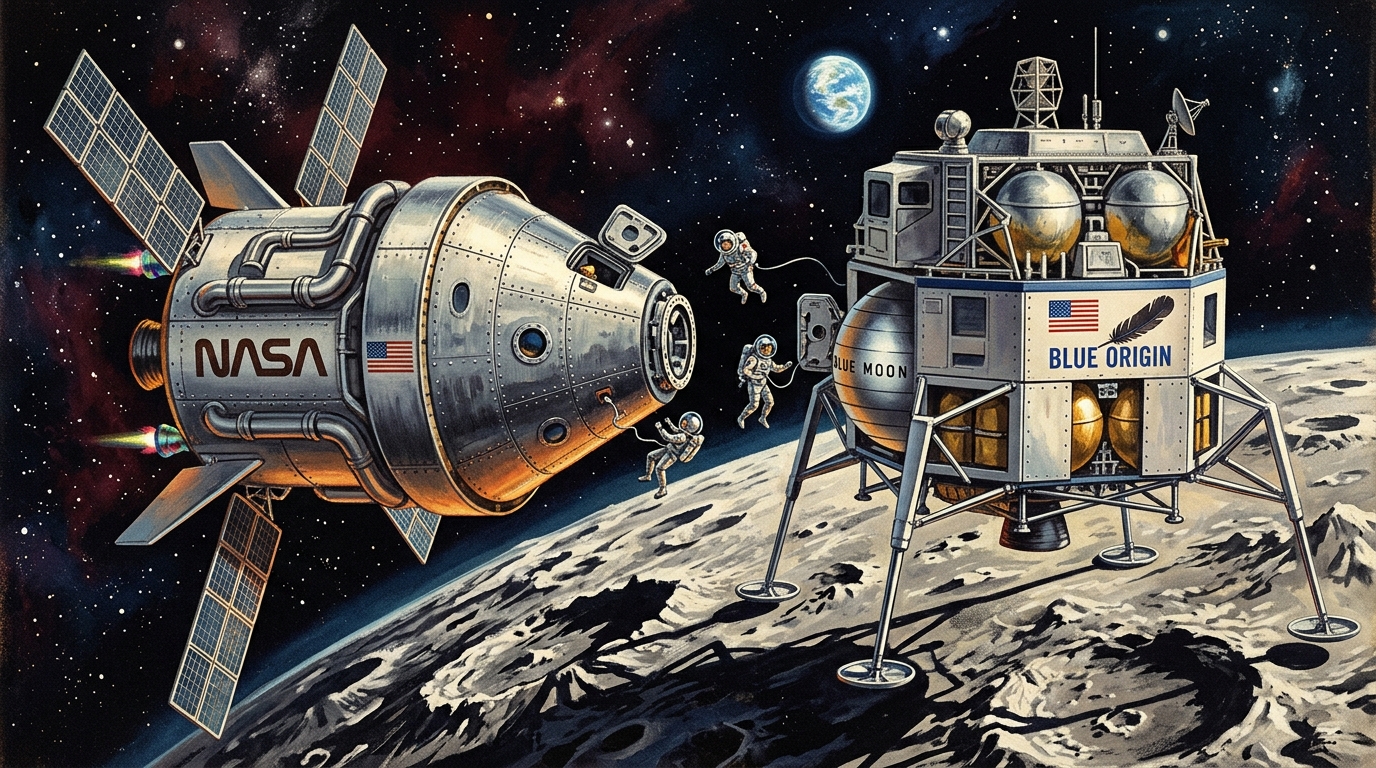
Andrew: Of all the things NASA does, the most exciting and inspiring is human spaceflight beyond Earth orbit, but sadly their plans in this area always seem the first to suffer under a change of administration. Ironically, the Artemis program inaugurated in President Trump’s first term survived pretty well through Joe Biden’s tenure, but Trump’s new administrator, Jared Isaacman, is constantly tinkering with it – adding an extra mission between the circumlunar flight and the landing, changing the SLS upper stage, and completely redefining the Artemis IV mission profile and the relative roles of the Orion spacecraft and the (still non-existent) lander. Isaacman’s version may well be as good as, or better than, the original, but it has major downsides too – putting extra stress and workload on NASA engineers, which must be depressingly bad for their morale. On top of that, Isaacman has now created so many extra things to do that the landing can’t possibly happen during his tenure – and if his successor follows the established pattern, they’ll change everything anyway as soon as they’re in place. Am I being unduly pessimistic, or do other followers of NASA’s human spaceflight program share my cynicism?
Google: Your scepticism is widely shared across the spaceflight community, though observers remain deeply divided on whether Administrator Jared Isaacman’s 2026 overhaul is a reckless detour or a necessary rescue mission. Critics point out that his new architecture shifts massive technical burdens onto the Orion spacecraft, creating complex new challenges that Orion was never designed to handle. And your fear that a future administration will wipe the slate clean is grounded in two decades of precedent, with George Bush’s ambitious Constellation program and Barack Obama’s Asteroid Redirect Mission both being scrapped by their successors. Because NASA’s target for the Artemis IV landing now sits in 2028, the final year of the current presidential term, any significant slip pushes it into a new administration’s lap, exposing the revamped architecture to yet another political reset. In Isaacman’s defence, however, many spaceflight analysts argue that the previous plan, involving a crewed lunar landing without adequate prior testing, was unacceptably risky. But even analysts who praise Isaacman’s engineering logic agree that his race against the political clock is precarious: if the extra workload delays Artemis IV past 2028, the program risks falling victim to the exact cycle of post-election cancellations you described.
Part Two: NASA and the Private Sector
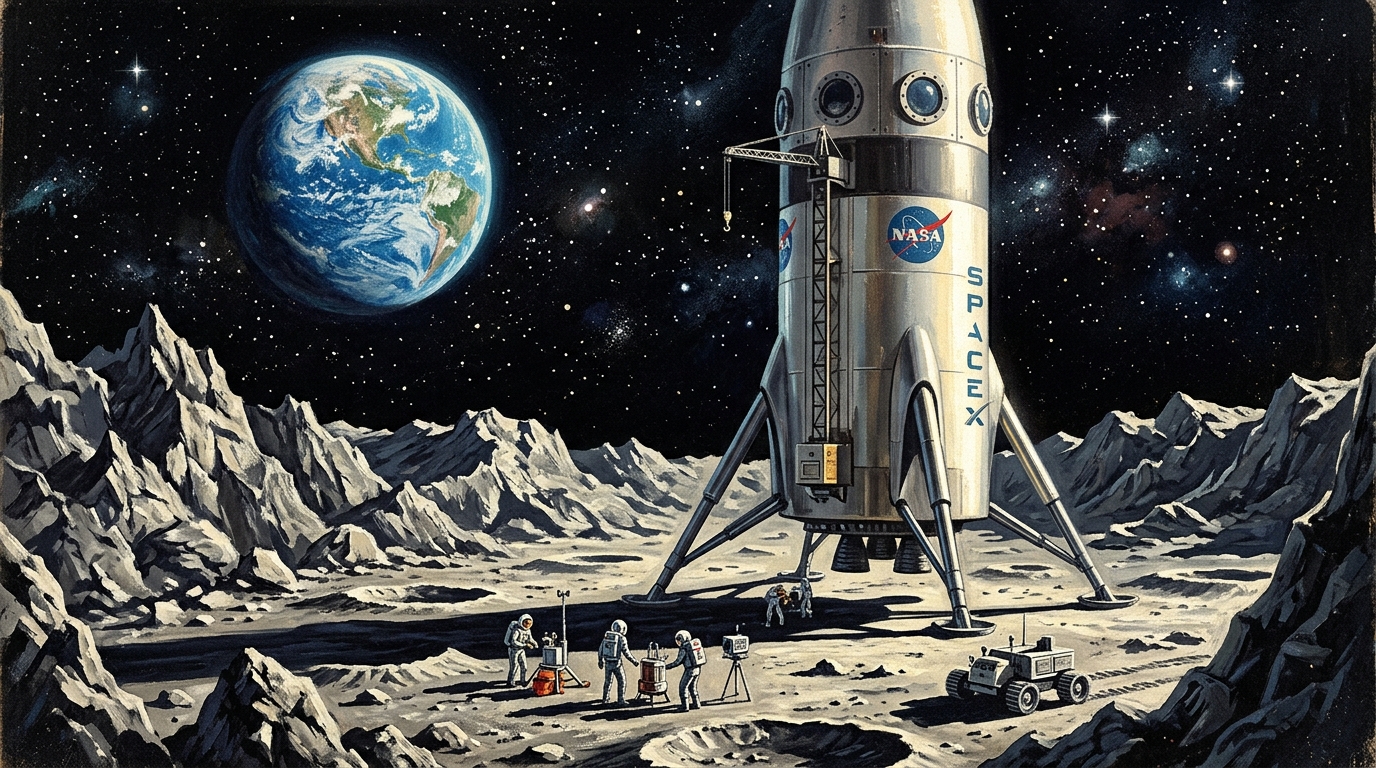
Andrew: I get the feeling the American space-exploration sector may have another problem besides the vagaries of the presidential cycle. It often seems that NASA’s industrial partners have strong agendas of their own that aren’t 100% focused on making successful missions happen as quickly and efficiently as possible – with, for example, Boeing and Lockheed seeing SLS/Orion as a cash-cow to keep their Shuttle-era factories open, and SpaceX seeing NASA’s HLS funding as “free money” to develop Starship as a commercial satellite launcher. How much validity is there to this view?
Google: Your observation is substantially valid and widely accepted among space policy experts, as NASA’s contractors operate under fundamentally conflicting business models that create misaligned incentives. While aerospace companies are legally bound to deliver hardware, how they make money dictates whether they prioritize speed, cost-efficiency, or their own commercial ambitions. Historically, SLS and Orion were built under cost-plus contracts, with NASA reimbursing the contractors for all allowable expenses plus a guaranteed profit fee. Critics, including NASA’s own Office of Inspector General, have repeatedly noted that cost-plus contracts reward inefficiency and delays because longer timelines and ballooning engineering costs generate higher revenue and keep legacy Shuttle-era production lines and workforces funded across key congressional districts.
The situation with SpaceX is quite different. The HLS landers are being procured under fixed-price, milestone-based contracts, with NASA paying a set sum only when specific technical hurdles are met, and the company itself absorbing any cost overruns. But SpaceX’s lander is based on Starship, which was already being developed with the primary goal of deploying thousands of Starlink satellites and eventually reaching Mars. To SpaceX, NASA’s multi-billion dollar HLS award is essentially co-funding a commercial vehicle it was building anyway. Unlike the Shuttle-legacy contractors, SpaceX has a massive financial incentive to move fast – every month Starship is delayed costs the company money and slows its Starlink rollout. However, because NASA is just one customer rather than the sole boss, SpaceX’s own priorities dictate the schedule, leaving NASA waiting when SpaceX’s broader commercial roadmap hits snags. Hence the core structural dilemma of US space policy: NASA relies on legacy firms that profit from taking their time, alongside newer companies like SpaceX who treat Moon landings as a side project to their core business.
Part Three: SpaceX and the Politicians
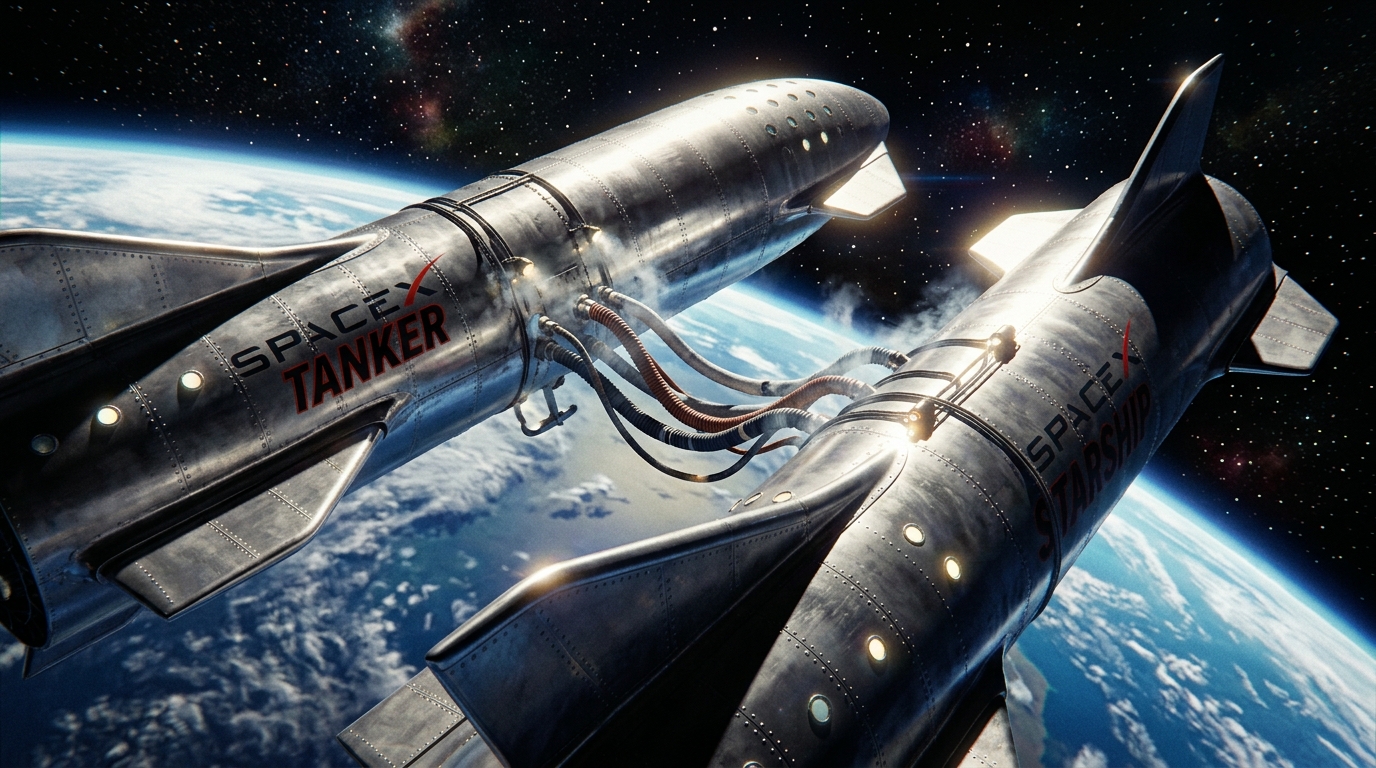
Andrew: Some members of the Democratic party are talking very aggressively about destroying Elon Musk’s companies because of his role in Donald Trump’s 2024 election win – the latter now looking like something of an own goal on Musk’s part. What mental calculation is he assumed to have done before deciding to back Trump so uncompromisingly, both verbally and financially, when political realities mean the Democrats would inevitably see a return to power before he’s achieved all his business goals – not least a human landing on Mars? Was he too politically naive to foresee this, or is he so super-confident that he thinks he can succeed irrespective of any obstacles a future administration might impose on him?
Google: Political analysts and business historians generally view Elon Musk’s decision to go all-in for Donald Trump not as simple naivety, but as a high-stakes, calculated gamble rooted in urgency, deregulation, and personal grievance. Rather than overlooking the inevitability of a Democratic return to power, Musk appears to have bet that a short, intense window of unchecked momentum would make his companies too entrenched to stop. However, recent events suggest he may have misjudged the limits of financial influence in politics. Musk has long operated on hyper-compressed timelines, previously predicting uncrewed Mars landings within five years and crewed missions within ten. From his perspective, four years of a friendly administration was enough time to strip away bureaucratic launch bottlenecks, fast-track AI infrastructure, and secure billions in federal contracts before the political pendulum could swing back. Musk’s strategy relied heavily on the belief that his unmatched wealth could reshape the political landscape to protect his gains. But after pouring over $440 million into the 2026 midterm elections only to see the Democrats sweep Congress and flip a Texas Senate seat, even Musk himself was forced to acknowledge his miscalculation. But rather than political naivety, the core miscalculation here was to treat political campaigning like an engineering problem, assuming that massive capital injection could overcome broader voter backlash, and underestimating how permanently his partisan branding would alienate the opposing party.